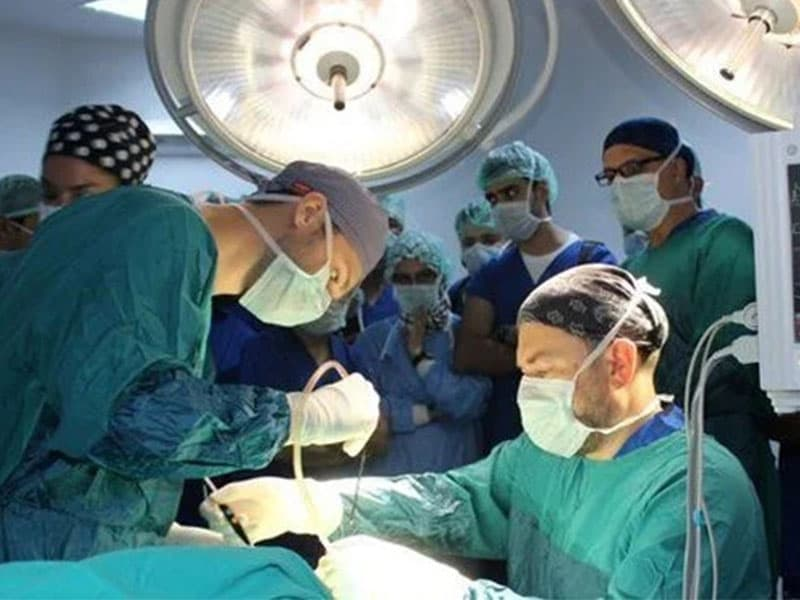



In Antalya, 68-year-old Yahya Arısoy, who was diagnosed with colon cancer, was discharged one day after undergoing surgery with the Transanal Minimally Invasive Surgery method.
Arısoy, a retired worker in Isparta, applied to Assoc. Prof. Dr. Bülent Dinç, a faculty member of the General Surgery Department at Antalya Training and Research Hospital of the University of Health Sciences, due to a change in his bowel habits one year ago.
As a result of the examinations, cancer was detected in his large intestine (colon), and it was determined that Arısoy’s cancer was in the early stage.
Arısoy, who underwent surgery in Antalya with the Transanal Minimally Invasive Surgery method, was discharged the next day.
"There Was No Surgical Scar"
Assoc. Prof. Dr. Bülent Dinç, who performed the surgery, stated in his remarks to an AA correspondent that approximately one million people worldwide are diagnosed with colon and rectum cancer each year, and that in Turkey this number is between 8 and 10 thousand.
Emphasizing that, in lay terms, large intestine cancers are among the commonly seen types of cancer in Turkey, Dinç noted that the treatment of colon and rectum cancers is among those performed surgically.
Stating that the region called the rectum is the last 15 centimeters of the large intestine, Dinç said, "The problematic part of the large intestine is removed. Then, the lymphatic system located at the back is cleared, and the intestines are connected end to end to complete the surgery. If it is a very low-level rectum tumor, meaning very close to the anus, then in such patients the anus is also removed and the surgery is completed. We performed this surgery with a different method. Especially in early-stage rectum cancers, we performed this surgery by entering through the anus without creating any surgical scar on the patient’s abdomen." he said.
"We Sent Him Home The Next Day"
Dinç stated that Transanal Minimally Invasive Surgery is a method applied in patients with early-stage rectum cancer and with a tumor size smaller than 3 centimeters, and continued as follows:
"Our patient applied to a healthcare institution in Isparta due to irregularity in defecation. A tumor was seen in the colonoscopy performed there. The patient came to us. In the examinations we conducted, we determined that it was early-stage rectum cancer. I stated that there was such a method and that we wanted to apply it. He accepted. We performed the patient’s surgery without any problems. He started eating the same day, and we sent him home the next day without any issues. Rectum and colon cancers may not show any symptoms until the last stage, and sometimes they can be noticed with a change in bowel habits. The patient group we fear the most are cases with no findings or those in which bleeding from the anus is dismissed by saying 'This is a simple hemorrhoid disease,' because in these patients the diagnosis is made very late."
Those Who Saw Me Standing Couldn’t Believe It"
Yahya Arısoy said that he had been having trouble with his bowel habits for a year, and that at first he was told, "You have inflammation in your intestines."
Stating that it was understood that it was a tumor after a colonoscopy was performed, Arısoy said the following:
"We came from Isparta to Antalya Training and Research Hospital. Here, in the examinations performed again, it was confirmed that there was a tumor. After that, they took me into surgery. After I came out of the surgery and woke up, it was as if I hadn’t had surgery. I wanted to move onto the stretcher they would take me to my room on my own, but they didn’t allow it. I didn’t eat for 3-5 hours. In the meantime, my son who was staying as an attendant fell asleep; I even went to the toilet on my own. Now, thank God, I’m fine. After my surgery, those who saw me standing said, 'Where did you have surgery from, you’re standing,' and they couldn’t believe it. I didn’t feel like a patient."