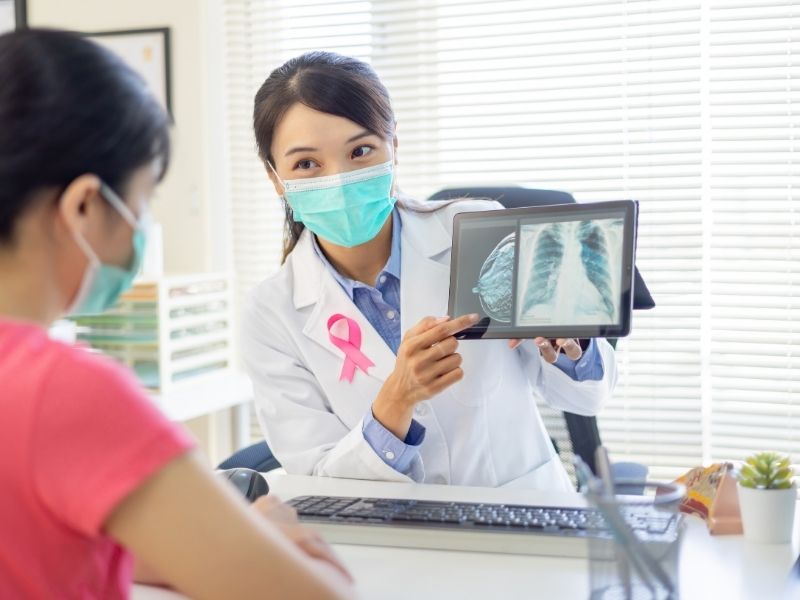
Breast cancer is cancers that develop in the cells of the breast tissue. Breast cancer ranks first among the types of cancer seen in women. Over a lifetime, 1 in every 8 women has a risk of developing cancer. Breast cancer in men can also be seen. This rate is 1 in every 100 men.
It can originate from any part of the breast tissue. The most common type is “ductal” cancers that originate from the breast ducts. “Lobular” cancers originating from the milk-producing glands are also common. In addition, there are rarer types originating from other tissues such as medullary, tubular, mucinous, etc.
Anything that increases your likelihood of getting breast cancer is classified as a “risk factor.” However, having this risk factor does not mean you will definitely develop breast cancer. Many women with breast cancer have the only known risk factor of being female.
Breast cancer risk factors are as follows:
Female gender:
Increasing age:
Presence of a high-risk condition in the breast: Lobular carcinoma in situ (LCIS) or atypical hyperplasia in the breast.
History of breast cancer: If you have had breast cancer in one breast, your risk of developing cancer in the other breast increases.
Family history of breast cancer:
Inherited genes that increase cancer risk: Breast cancer gene 1 and 2 (BRCA1 and BRCA2). These genes can greatly increase your risk of breast cancer and other cancers, but they do not make cancer inevitable. In individuals who are positive, 80% develop cancer.
Radiation exposure: Receiving radiation therapy to your chest as a child or young adult.
Obesity: Increases it 2-fold.
Early onset of menstruation: Under age 12
Delayed menopause:
Having your first child at an older age: Having the first birth after age 30.
Never having been pregnant:
Postmenopausal hormone therapy:
Alcohol use:
Breast Cancer Symptoms
A breast mass that feels different from the breast tissue. The mass is generally hard and painless.
A change in the size, shape, or appearance of the breast
Development of asymmetry between the two breasts
Dimpling of the breast skin
Inward turning of the nipple
Presence of bloody discharge from the nipple
Peeling, crusting, or flaking of the pigmented area of skin surrounding the nipple (areola) or the breast skin
An orange peel appearance of the skin over the breast
Breast self-examination, annual mammography, and annual doctor examination are very important for early diagnosis. Breast cancer can be treated with a success rate close to 100% when intervention is made while it is a small mass within the breast. Another feature that distinguishes breast cancer from other cancers is that it can be evaluated within “cancer screening programs.” Therefore, women who have no complaints or masses in their breasts should pay attention to screening methods.
Breast Cancer Diagnosis
Breast examination: Both the breast tissue and the underarm lymph nodes are checked.
Mammogram: Mammography is an X-ray of the breast. Mammograms are often used to screen for breast cancer.
Breast ultrasound: Ultrasound uses sound waves to produce images of structures deep within the body. Ultrasound can be used to determine whether a new breast mass is a solid mass or a fluid-filled cyst.
Breast biopsy: The only definitive way to diagnose breast cancer is a biopsy. A biopsy can be taken with a needle under imaging guidance, or it can be done by wire localization or directly surgically.
Breast magnetic resonance imaging (MRI): Before a breast MRI, you receive an injection of dye. Unlike other imaging tests, MRI does not use radiation to create images.
Staging Tests in Breast Cancer
Blood tests such as a complete blood count
Mammography of the other breast
Breast MRI
Bone scan
Computed tomography (CT) scan
Positron emission tomography (PET) scan
Not all female cancer patients may need all of these tests. Appropriate tests should be selected based on the individual patient.
Breast cancer stages range from 0 to IV, and 0 indicates noninvasive cancer or cancer located in the milk ducts. Stage IV breast cancer, also called metastatic breast cancer, indicates cancer that has spread to other parts of the body.
Breast cancer staging also takes into account the grade of your cancer; the presence of tumor markers such as receptors for estrogen, progesterone, and HER2 changes the expected lifespan and the type of treatment.
Breast Cancer Treatment
Breast cancer treatment is determined according to the type, stage, and grade of your breast cancer, its size, whether the cancer cells are sensitive to hormones, the size of the breast, and the preferences of the patient and the doctor.
What Are the Surgical Treatment Methods for Breast Cancer?
Removal of the Breast Cancer (Lumpectomy)
Breast-conserving surgery or wide local excision is the term used. The tumor and the surrounding healthy tissue margin are removed. Lumpectomy can be performed in patients with tumor and breast size compatibility. People with large tumors may undergo chemotherapy before surgery to shrink a tumor and make it possible to remove it completely with a lumpectomy procedure.
Removal of the Entire Breast (Mastectomy)
Mastectomy is the procedure of removing all breast tissue. In selected cases, skin-sparing mastectomy and nipple-sparing mastectomy can be performed to preserve the appearance of the breast.
Removal of a Limited Number of Lymph Nodes (Sentinel Node Biopsy)
To determine whether the cancer has spread to your lymph glands, a sample of underarm lymph nodes may be taken. If cancer is not found in these lymph nodes, the chance of finding cancer in any of the remaining lymph nodes is low and there is no need to remove any other nodes.
Removal of Lymph Nodes (Axillary Lymph Node Dissection)
If cancer is found in the sentinel lymph nodes, the other lymph nodes in your underarm need to be removed.
Removing Both Breasts
Some women who have cancer in one breast may choose to have their other (healthy) breast removed (contralateral prophylactic mastectomy) if the risk of breast cancer in the other breast is very high due to genetic predisposition or a strong family history.
Radiation (Beam) Therapy in Breast Cancer
Radiation therapy uses high-powered energy beams such as X-rays and protons to kill cancer cells. Radiation therapy applied to the entire breast is commonly used after lumpectomy.
Large breast cancers or cancers that have spread to the underarm lymph glands may warrant radiation therapy to the chest wall after mastectomy.
Side effects of radiation therapy include fatigue and redness where the radiation is aimed. Breast tissue may appear swollen or firmer. Rarely, more serious problems may occur, such as damage to the heart or lungs, or very rarely second cancers in the treated area.
Breast Cancer Chemotherapy
Chemotherapy is the use of various chemicals to destroy fast-growing cells, such as cancer cells. If your cancer has a high risk of recurrence or spreading through your body, your doctor may recommend chemotherapy after surgery. Sometimes it can be given before surgery to shrink larger tumors.
In cancers that have spread through the body, chemotherapy treatment is also given. Thus, both the cancer is tried to be controlled and the symptoms caused by the cancer can be reduced.
Side effects often include hair loss, nausea, vomiting, fatigue, and infection. Rare side effects can include early menopause, infertility (if premenopausal), heart and kidney damage, nerve damage, and very rarely blood cell cancer.
Breast Cancer Hormone Therapy
Hormone therapy is used to treat breast cancers that are sensitive to hormones. These cancers are called estrogen receptor positive (ER positive) and progesterone receptor positive (PR positive) cancers.
Hormone therapy can be used before or after surgery or other treatments to reduce the likelihood of the cancer recurring. If the cancer has already spread, hormone therapy can shrink and control it..
Targeted Therapy Drugs
Targeted drug treatments attack specific abnormalities within cancer cells. For example, it focuses on a protein called human epidermal growth factor receptor 2 (HER2), which some breast cancer cells overproduce. The protein breast cancer helps cancer cells grow and survive. Drugs that target cells that make too much HER2 can damage cancer cells while sparing healthy cells.
Breast Cancer FAQ
1. Breast cancer who is it seen in? Being female alone is enough for breast cancer to occur. Besides this, the likelihood of breast cancer may increase in people exposed to radiation, those with obesity, and those receiving hormone therapies.
2. How many stages of breast cancer are there? Breast cancer can range from stage 0 to stage 4. In the first stage, the cancer is only in the milk ducts. In stage 4, it has spread to other parts of the body.
3. Is breast cancer genetic? The risk of developing breast cancer is higher in people with a family history of breast cancer.
4. What is mammography? Mammography refers to taking an X-ray image of the breast tissue. It is the best method for diagnosing breast cancer.
5. Can breast cancer recur? If breast cancer is detected early and treated well, the likelihood of recurrence is low. After breast cancer, there is a possibility that breast cancer may occur again or other cancers may develop.
Legal Disclaimer: In any surgical or interventional procedure, results may vary from person to person. It is recommended that you obtain detailed advice from your physician before the procedure.